
Bloated After Every Meal? Here's How to Figure Out Which Reason Is Yours
If you're bloated after every meal, you've probably already tried the obvious things. Eating slower. Avoiding "gassy" foods. Going dairy-free for a month. And still, the same distended, uncomfortable feeling shows up almost every time you eat.
There isn't one cause of bloating after every meal. There are several, and they have different mechanisms, different timing patterns, and different triggers. What looks like "I bloat no matter what I eat" is often actually a specific pattern, just not the one you're looking at.
This post walks through the main causes and a simple self-triage based on the signals your symptoms are already giving you. Timing, food type, bowel habits, and posture, separately, often point toward a specific cause. Together, they usually point toward a starting place. If you're already tracking and still can't see the pattern, it might be because food isn't the only variable worth logging.
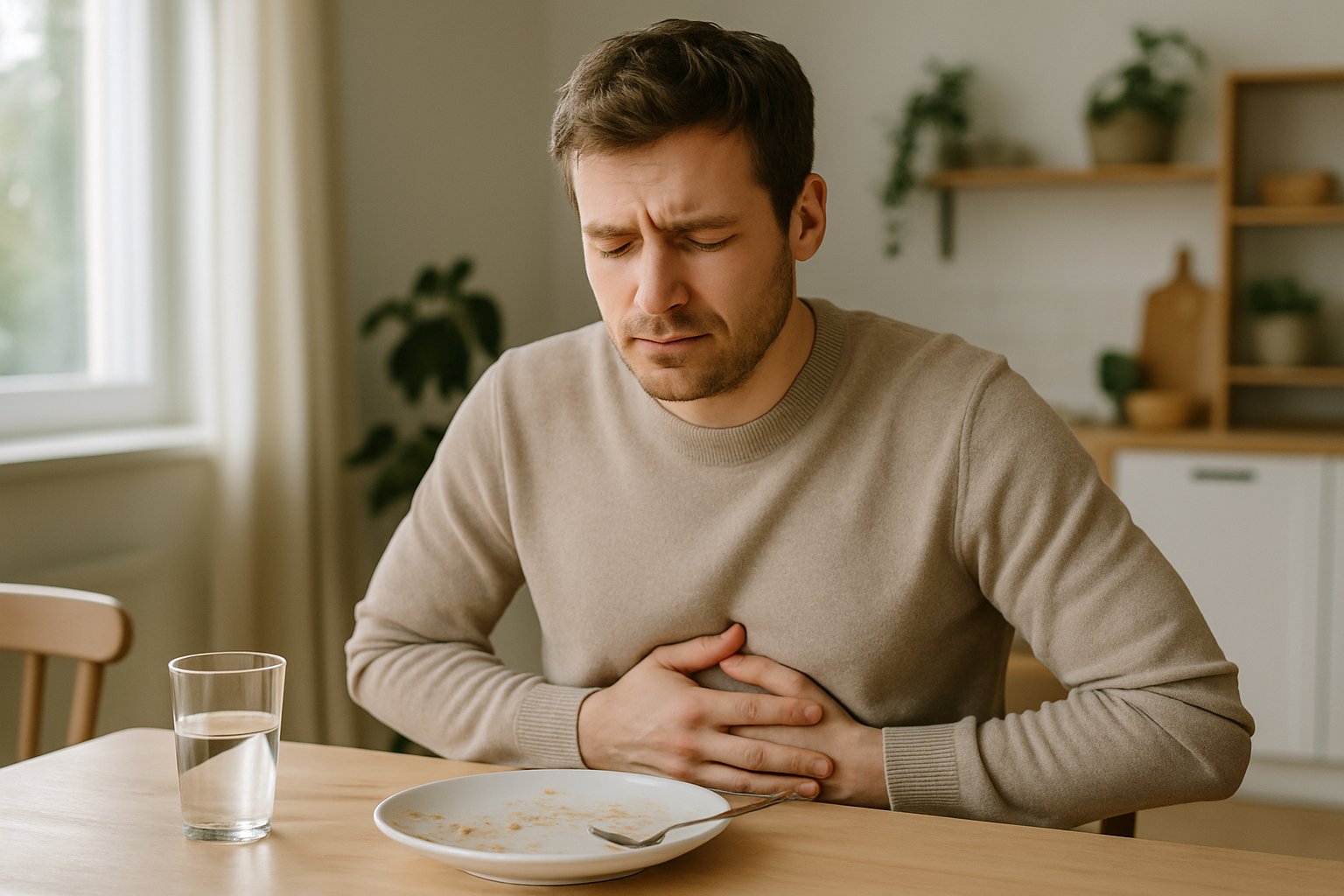
The Main Causes of Bloating After Every Meal
Not all post-meal bloating has the same mechanism. Here's a quick map of the most common causes and what each one is actually doing.
Slow gastric emptying
If the stomach empties more slowly than normal, food sits longer, which can cause a heavy, full feeling that progresses into distension. Bloating that starts during or immediately after eating, especially after fatty or protein-heavy meals, often points here.
Motility dysfunction
When intestinal transit is slow overall, gas builds throughout the system and has nowhere to go. This tends to produce bloating that builds across the day rather than spiking right after meals.
Abdominophrenic dyssynergia (APD)
APD is a functional reflex issue where the diaphragm and abdominal wall move in the wrong direction when the gut signals distension. The result is visible abdominal protrusion that's not caused by gas. People with APD often notice bloating almost immediately after eating, even after just water, and it doesn't improve after passing gas or going to the bathroom. Lying flat on your back sometimes helps, because the posture neutralizes the reflex.
Visceral hypersensitivity
Is your stomach visibly distended, or does it just feel that way? Visceral hypersensitivity means the gut's nervous system amplifies internal pressure signals into discomfort or pain. The feeling of bloating can be very real without the same degree of visible distension.
Your Pattern Is a Clue: A Simple Self-Triage
The goal here isn't to pinpoint a definitive cause from symptoms alone. It's to narrow down the most likely starting place so you're not running every test at once.
When does the bloating start?
Within 30 to 90 minutes of eating: This timing is characteristic of fermentation in the small intestine. SIBO is the main suspect, though it can also be FODMAP overload more generally. The body hasn't had time to move food to the colon, so the gas is being produced somewhere earlier in the gut. If you've treated SIBO before and this pattern is back, these are the usual reasons it recurs.
Immediately after eating, or even during the meal: If bloating starts before fermentation could realistically have happened, the mechanism is more likely related to stomach motility or a reflexive response. Slow gastric emptying fits here, as does APD if you notice visible distension (rather than just discomfort) that doesn't resolve after the bathroom.
Builds throughout the day regardless of meals: If you wake up feeling relatively fine and progressively get more uncomfortable as the day goes on, motility is more likely the driver. Gas is accumulating across the whole system, not just after one meal.
💡 The "progressive bloating across the day" pattern is one of the more reliable indicators of a motility or slow transit issue rather than a post-meal fermentation issue. The two can coexist, but the timing difference matters.
Does it track to specific food types?
Worse after high-FODMAP foods (onions, garlic, legumes, wheat, apples, dairy): Points toward either SIBO or a general FODMAP intolerance. The fermentable carbohydrates in high-FODMAP foods are the fuel for bacterial fermentation.
Worse after large, fatty, or protein-heavy meals: Stomach emptying slows significantly after high-fat meals. If these make your bloating significantly worse than a lighter meal, slow gastric emptying or low stomach acid is worth considering.
Same bloating regardless of what you eat: This often suggests the issue isn't primarily food-driven. Motility dysfunction, APD, or visceral hypersensitivity tends to affect every meal because the underlying mechanism is structural or neurological, not dietary.
What are your bowel habits like?
Your transit pattern gives another clue.
Constipation-dominant or infrequent bowel movements: Methane-producing organisms are strongly associated with slow transit and constipation. If you're bloated, constipated, and the bloating doesn't improve much after going to the bathroom, methane-SIBO is worth testing for.
Loose, urgent, or diarrhea-dominant: Hydrogen-dominant SIBO is more commonly associated with urgency and loose stool. The stress-gut axis is also relevant here, as chronic stress can speed up transit and generate urgency.
Alternating constipation and loose stool: This pattern sometimes reflects different mechanisms working at different times, or what's sometimes called "hidden" constipation, where some areas are slow while others move too quickly.
🔎 If you're trying to track this pattern and actually make sense of it: Noorish takes your full symptom history (timing, food types, bowel habits, stress patterns) and builds a structured action plan for what to investigate next. Easier than keeping notes in three different places. Start here →
What Your Triage Suggests About Next Steps
The triage above points toward a starting hypothesis. What you do with it isn't necessarily "run a test" - for most of these causes, there's something concrete you can try first.
If the pattern points toward SIBO: A breath test (lactulose or glucose) is the standard way to confirm, and worth doing so you know whether you're dealing with hydrogen-dominant or methane-dominant overgrowth (they require different approaches). This is one case where testing before treating does make sense, since the protocols differ. Worth knowing going in what a standard workup does and doesn't check for, since a breath test usually isn't part of the default panel.
If the pattern points toward motility dysfunction:
This is where most people stay stuck the longest, partly because "slow gut" sounds vague and partly because the standard advice (eat more fiber, drink more water) doesn't actually address the mechanism.
The gut has an internal pacemaker called the migrating motor complex (MMC), a wave of muscular activity that sweeps the small intestine clean between meals. Chronic stress, gut infections, and irregular eating patterns all disrupt it.
Things that actually move the needle:
- Walk after meals. 15 to 20 minutes is well-studied for accelerating gastric emptying and bowel transit. More effective than most supplements.
- Stop eating between meals. The MMC only fires in a fasted state. Grazing keeps it permanently off. Spacing meals 3 to 4 hours apart is one of the simplest interventions for motility.
- Magnesium citrate before bed supports bowel transit and relaxes smooth muscle. 200 to 400mg is a reasonable starting point.
- Ginger has a genuine prokinetic effect. Capsules or fresh ginger tea before meals, consistently for two weeks, is a fair trial.
- Diaphragmatic breathing after meals. The vagus nerve regulates gut motility directly. Five minutes of slow, deep breathing with a long exhale activates vagal tone and stimulates movement. This sounds low-stakes because it is, but it's also genuinely useful.
- Abdominal massage, following the colon clockwise, can physically move things along when transit is sluggish.
If the pattern points toward APD:
APD is probably the most underrecognized cause on this list, and also one of the most addressable once you know what you're dealing with. The mechanism is a misfiring reflex where the diaphragm and abdominal wall move in the wrong direction when the gut signals any fullness, creating visible distension that doesn't respond to normal bloating remedies.
Things to try:
- Diaphragmatic retraining. Lie down after eating. One hand on chest, one on belly. On the exhale, consciously draw the abdomen inward. The goal is retraining the reflex - diaphragm up on exhale, abdomen in - which is the opposite of what APD does. Ten minutes after meals, consistently over weeks.
- Biofeedback therapy uses electromyography to retrain the diaphragm-abdominal wall coordination in real time. Effective, but requires a practitioner who actually knows APD exists - not all do.
- Pelvic floor physiotherapy if there's also straining, a sense of incomplete emptying, or pelvic pressure. The pelvic floor and diaphragm work as a system.
Worth specifically looking for a practitioner familiar with APD rather than a general physio, the condition is underrecognized and the exercises are specific.
If the pattern points toward visceral hypersensitivity:
The gut has its own neural network and it can become sensitized - normal sensations like mild fullness or small amounts of gas register as pain or significant discomfort. Stress and anxiety almost always make it worse, and often that correlation is the clearest signal.
Things that have real evidence behind them:
- Gut-directed hypnotherapy. The Manchester protocol for IBS has more clinical trial data than almost anything else in this space. It directly addresses the gut-brain signaling loop and has shown lasting effects. Available through several online providers now.
- Vagal stimulation practices. Cold water on the face, humming, gargling, slow exhale-heavy breathing. Done regularly, these build vagal tone and reduce gut nervous system reactivity.
I've been through pieces of most of this. What actually helped me move forward wasn't finding a single answer - it was building a clear enough record of my symptoms and what I'd tried that I could actually see patterns. That picture is what made practitioner conversations useful instead of circular.
That's what Noorish is built for: taking your full gut history and generating a structured action plan from it. If you're at the "I don't know what to try next" stage, it's worth a look.
Conclusion
Bloating after every meal is frustrating partly because it feels like there's no pattern. But most of the time, there is one. The timing, the foods, the bowel habits, the posture, those signals are already there. They just need to be looked at together, not in isolation.
The most common causes each leave a different fingerprint. SIBO bloats you within the hour. APD bloats you immediately regardless of what you ate. Motility dysfunction builds through the day. Food sensitivities accumulate over time. The pattern you're in points toward a starting place for investigation.
You don't have to try everything. You just have to start with the hypothesis that fits your picture best.
If you want help building that picture and getting a structured plan for what to try next, Noorish is the place to start.
Follow on Instagram for more on working through gut symptoms without the guesswork.
🔎 Noorish: Gut Health Action Plan
Bloated after every meal and not sure where to start? Noorish maps your full symptom pattern and tells you what to investigate first.
- ✅ Build a structured gut symptom history to share with your doctor
- ✅ Understand what's actually driving your symptoms
- ✅ Get a science-based action plan for what to try next
- ✅ Optional: validation from a real nutritionist
FAQ
Why am I bloated after every single meal?
Bloating after every meal usually means the mechanism isn't primarily about one specific food. Common causes include SIBO (where bacteria in the small intestine ferment food quickly), slow gastric emptying, motility dysfunction, or abdominophrenic dyssynergia (a functional reflex issue unrelated to gas). The timing and pattern of your bloating are the most useful clues for telling these apart.
Is it normal to be bloated after every meal?
Some mild fullness after eating is normal. Consistent distension, discomfort, or visible bloating after every meal isn't. It's common, but common and normal aren't the same thing. Most people who experience consistent post-meal bloating have an identifiable functional cause worth investigating.
How do I stop bloating after every meal?
The most direct answer: figure out which cause fits your pattern first. SIBO, slow gastric emptying, food sensitivities, motility issues, and APD each require different approaches. Trying a generic fix without knowing the mechanism behind your bloating is why most people cycle through remedies without lasting results.
What causes constant bloating no matter what I eat?
When bloating happens regardless of food type, the cause is more likely mechanical or neurological than dietary. APD (where the diaphragm and abdominal wall create visible distension without excess gas), motility dysfunction (where transit is slow throughout the system), and visceral hypersensitivity (where the gut amplifies internal pressure signals) all fit this pattern.
Can SIBO cause bloating after every meal?
Yes. SIBO causes bacteria in the small intestine to ferment food as it arrives, producing gas before it can reach the colon. This typically causes bloating within 30 to 90 minutes of eating, and often worsens through the day as fermentation accumulates. Breath testing measures hydrogen and methane levels and can suggest whether SIBO is present.
How do I know if my bloating is SIBO or something else?
Timing is the clearest initial clue. SIBO bloating typically starts within 30 to 90 minutes of eating and is often worse with high-FODMAP foods. Immediate bloating (during or right after eating) points more toward stomach motility issues or APD. Bloating that builds through the day without a meal trigger points more toward slow transit. A breath test can confirm or rule out SIBO specifically.