
You Got an IBS Diagnosis. That's Not Actually a Diagnosis.
If you've sat through a GI appointment, gotten bloodwork and maybe a colonoscopy, and walked out with "it's IBS" as the answer, you know the specific kind of confusion that follows. You finally have a name for what's been happening. Nobody explained what that name actually means, and you're left wondering what to do after an IBS diagnosis besides "manage your stress" and "try cutting something out."
IBS isn't a finding, it's a bunch of symptoms. The investigation that's supposed to tell you what's actually going on usually stops right where this label starts. Below is what the label actually means, and what a real next step looks like.
What "IBS" Actually Means (And What It Doesn't)
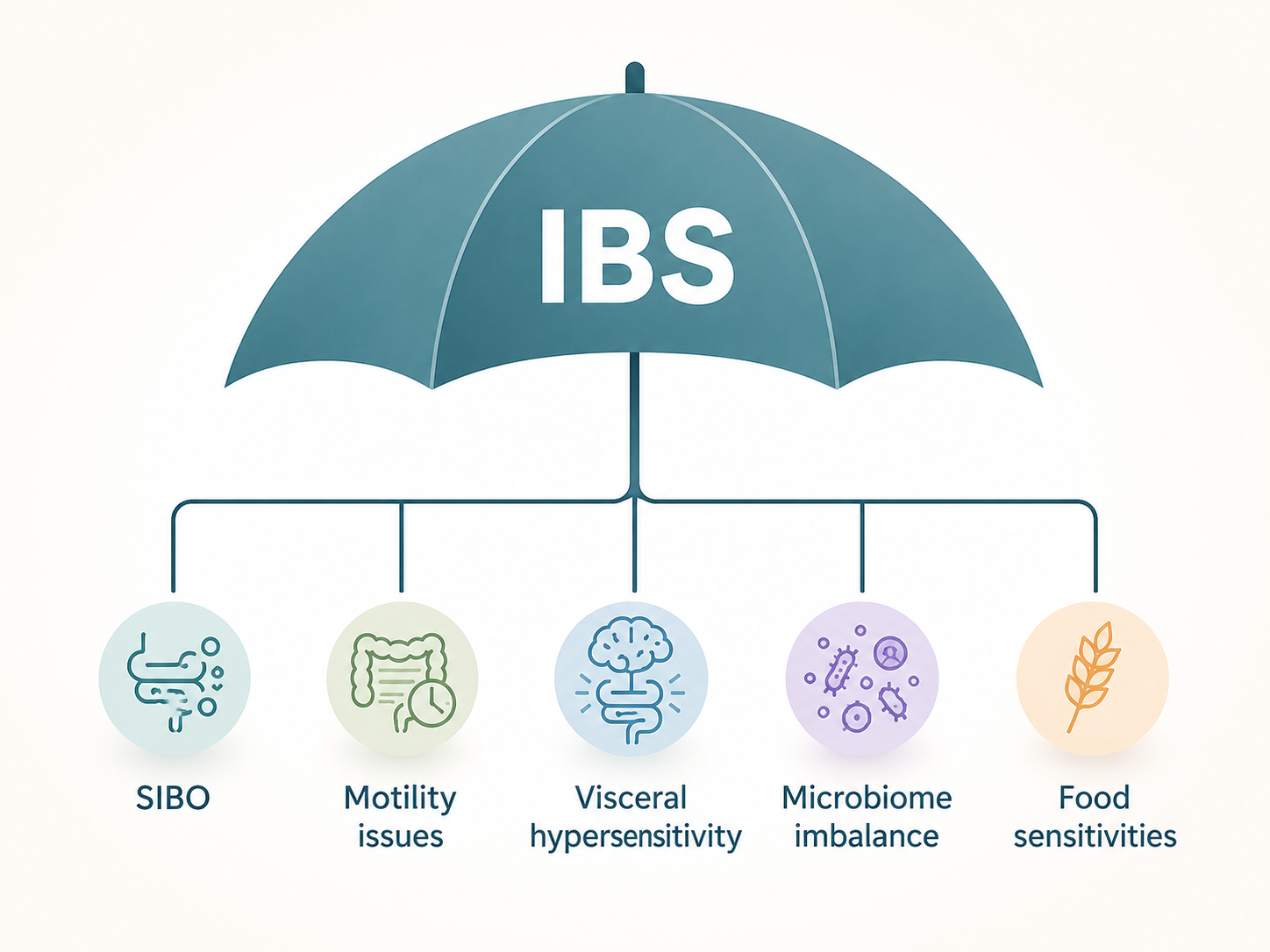
IBS, or irritable bowel syndrome, describes a pattern of symptoms, not a cause. The current diagnostic standard, the Rome IV criteria, defines it as recurring abdominal pain (at least one day a week for three months) tied to a change in how often you go or what it looks like. That's it. There's no scan, no blood marker, no biopsy that says "yes, this is IBS."
💡 Rome IV doesn't actually require ruling everything out before a diagnosis. Doctors mainly check for red-flag signs (blood in stool, unexplained weight loss, onset after 50) and otherwise make the call from your symptom pattern alone. That's faster for the doctor. It's also why two people with completely different underlying issues can walk out with the same label.
Somewhere around 1 in 7 people meet criteria for IBS. That's a huge range of different gut situations filed under one name. Inside that umbrella: SIBO (small intestinal bacterial overgrowth), motility issues, visceral hypersensitivity (your gut registering normal digestion as pain), microbiome imbalance, specific food sensitivities, the gut-brain axis (your nervous system amplifying gut signals under stress) - to name a few. Any one of these, or a combination, can produce the same surface symptoms. If bloating is your main symptom, this self-triage walks through how those mechanisms usually show up differently.
Someone gets a colonoscopy and bloodwork that comes back completely normal, gets told "it's IBS," and is still bloated every afternoon with no idea why. That's exactly how the process is built to work: rule out the dangerous stuff, label what's left. It doesn't make your life easy. (Here's what those tests actually check for, and what they don't.)
This isn't a knock on your doctor specifically. GI investigation in most health systems is built to rule out serious disease first, not to identify the mechanism behind functional symptoms. Dr. Mark Pimentel, who directs the GI Motility Program at Cedars-Sinai and has spent decades researching SIBO, has talked about the field moving away from treating IBS as a "wastebasket diagnosis," recognizing there are usually other, identifiable things going on underneath it.
Why "Manage Your IBS" Is Hard to Do Without More Information
Once you have the label, the standard advice is some combination of: try a low FODMAP diet, reduce stress, maybe add fiber. None of that is wrong, exactly. The problem is it's written for an average case, and your gut symptoms probably aren't average.
Low FODMAP is a good example. Research out of Monash University (the team that developed it) found that roughly 3 in 4 people with IBS see real symptom improvement on it, usually within 2 to 6 weeks (source: Monash University FODMAP research). That's a solid number. It also means 1 in 4 people do everything right and feel nothing, not because the diet failed, but because FODMAPs weren't their issue in the first place.
Someone with constipation-dominant IBS tries the exact protocol that worked for their friend's diarrhea-dominant IBS, gets two weeks in, feels no different, and concludes "diets just don't work for me." Different subtype, different mechanism, different starting point.
⚠️ If you tried a protocol for less than 2-3 weeks and judged it a failure, that might be too short a window to know anything. Gut symptoms have a lot of day-to-day noise. You need enough time to see past the noise before you can call something a dud.
Without knowing whether SIBO, a motility issue, the stress-gut axis, or food sensitivity is actually behind your symptoms, "try the standard advice" is closer to a guess than a plan. SIBO alone shows up in roughly 31% of IBS cases in pooled data from a 2020 meta-analysis of 25 case-control studies, but estimates across the research swing much wider than that (anywhere from under 5% to over 80%) mostly because different breath tests and positivity cutoffs produce very different numbers. To make an informed call about where to start, you'd want to know your subtype, whether you've been tested for SIBO at all, and what your symptoms actually correlate with day to day.
🔎 If you're trying to figure out which of these is actually driving your symptoms: Noorish builds a structured action plan from your full symptom history, so you're working from your own pattern instead of the average case. Start here →
What Structured Self-Investigation Looks Like
Investigating further means getting more specific about your own pattern.
Step 1: track in a way that reveals patterns, not just events. Logging "bloated today" isn't that useful by itself. Time of day, what you ate, sleep, stress, where you are in your cycle if relevant: all of it matters more as a pattern across weeks than as a single entry.
Step 2: consider whether more testing fits your specific pattern. A SIBO breath test makes sense for some symptom patterns and not others. Same with stool testing or motility studies. This isn't "get every test." It's matching the test to what your pattern is actually pointing at. (Here's how to bring that pattern into an appointment so it actually gets discussed.)
Step 3: test one variable at a time, against a baseline. Cut something, or add something, for a defined stretch (2-4 weeks is reasonable), and compare it to how you were doing before. Change three things in the same week and you'll have a vague sense something helped, with no idea which part actually did the work.
Someone cutting out gluten, dairy, and sugar all in the same week, feeling somewhat better, and not being able to tell which one (if any) mattered. A month later they're still avoiding all three "just in case," with no real signal either way.
| Possible mechanism | What it can feel like | A way to start investigating |
|---|---|---|
| SIBO | Bloating that builds through the day, gas, and either diarrhea or constipation depending on which gas type is involved | Breath testing |
| Motility issue | Irregular timing, constipation and diarrhea alternating | Motility studies, symptom-timing log |
| Visceral hypersensitivity | Pain out of proportion to what's actually happening in the gut | Gut-directed therapies, symptom-stress correlation tracking |
| Food sensitivity | Symptoms tied to specific foods, not all food | Elimination and reintroduction, one item at a time |
| Gut-brain axis / stress | Flares that track with stress, sleep, or cycle | Stress-symptom correlation tracking |
💡 Worth knowing: the goal isn't to solve everything in one pass. It's to get real signal about your specific situation, one variable at a time. Slower, but it's signal you can actually trust.
This is the part that's genuinely tedious to do by hand: tracking consistently, remembering what you tried three weeks ago, noticing what actually moved and what didn't. Noorish turns your symptom history into a structured record and an action plan built around your specific pattern, instead of starting over from a blank notes app every time. If you're at the "I have the label, now what do I actually try" stage, that structure is probably what's missing.
Conclusion
The IBS label did do something real. It cleared the dangerous stuff off the table: no IBD, no celiac, nothing showing up on a scan. That's worth something. But it's the start of the real work.
What to do after an IBS diagnosis isn't really about managing a fixed condition. It's about figuring out which of the several things that fall under "IBS" is actually yours, then testing your way toward what helps. That's a different project than what most people are handed on their way out of that appointment.
🔎 Noorish: Gut Health Action Plan
Stop guessing which version of "IBS" you actually have, build a structured action plan around your real symptom pattern instead.
- ✅ Build a structured gut symptom history to share with your doctor
- ✅ Understand what's actually driving your symptoms
- ✅ Get a science-based action plan for what to try next
- ✅ Optional: validation from a real nutritionist
Still figuring out your own pattern? I post about it on Instagram as I go.
FAQ
What should I do first after being told I have IBS?
Understand what the label covers (a symptom pattern, not a cause) and what's inside that umbrella for you. Then start tracking symptoms in a way that reveals patterns: time of day, food, stress, sleep.
Is IBS a permanent condition?
Not necessarily. Symptoms often improve once you identify what's actually driving them (SIBO, a motility issue, a food trigger, the stress-gut axis) instead of applying generic advice to an unidentified cause.
Can IBS be resolved or only managed?
Depends on the mechanism. Some causes, like SIBO or a specific food sensitivity, can be addressed directly. Others, like a chronic motility issue, may need ongoing management. You won't know which until you investigate further.
What does an IBS label actually mean?
Your symptoms fit a recognized pattern (recurring abdominal pain tied to a change in bowel habits) and serious disease has been ruled out. It doesn't mean a cause has been found. Rome IV is a symptom-pattern match, not a mechanism finding.
Should I get more tests after an IBS label?
Maybe, depending on your pattern. A SIBO breath test makes sense for some presentations and not others. More testing isn't automatically the answer, but worth considering if your pattern points toward something specific and testable.
How do I know if I really have IBS and not something else?
Watch for red flags: blood in stool, unexplained weight loss, onset after age 50, a family history of colon cancer without appropriate screening. Any of those warrant a conversation with your doctor, regardless of an existing IBS label.