
All Your Gut Health Notes Are Everywhere. Here's How to Fix That
I have a Notion page with eleven test results in it, none labeled by date. A notes app full of half-finished food logs. A folder of screenshots from Reddit threads I meant to come back to. A stool test result I never matched against a breath test from months earlier. Let alone one million chatGPT conversations. Two years into dealing with gut symptoms, and I had, by any measure, a lot of information about my own body. None of it told me anything.
That's the part that's hard to explain to someone who hasn't lived it: the problem usually isn't that you haven't done the work. You've probably tracked, tested, and researched more than most people ever will. (If the research itself feels like the thing that's overwhelming you, that's a separate problem worth untangling too.) The problem is that all of it lives in different places, in different formats, with no dates attached half the time, so you can't actually look at it and see anything. Having a lot of information about your gut health history and being able to use it are two different things.
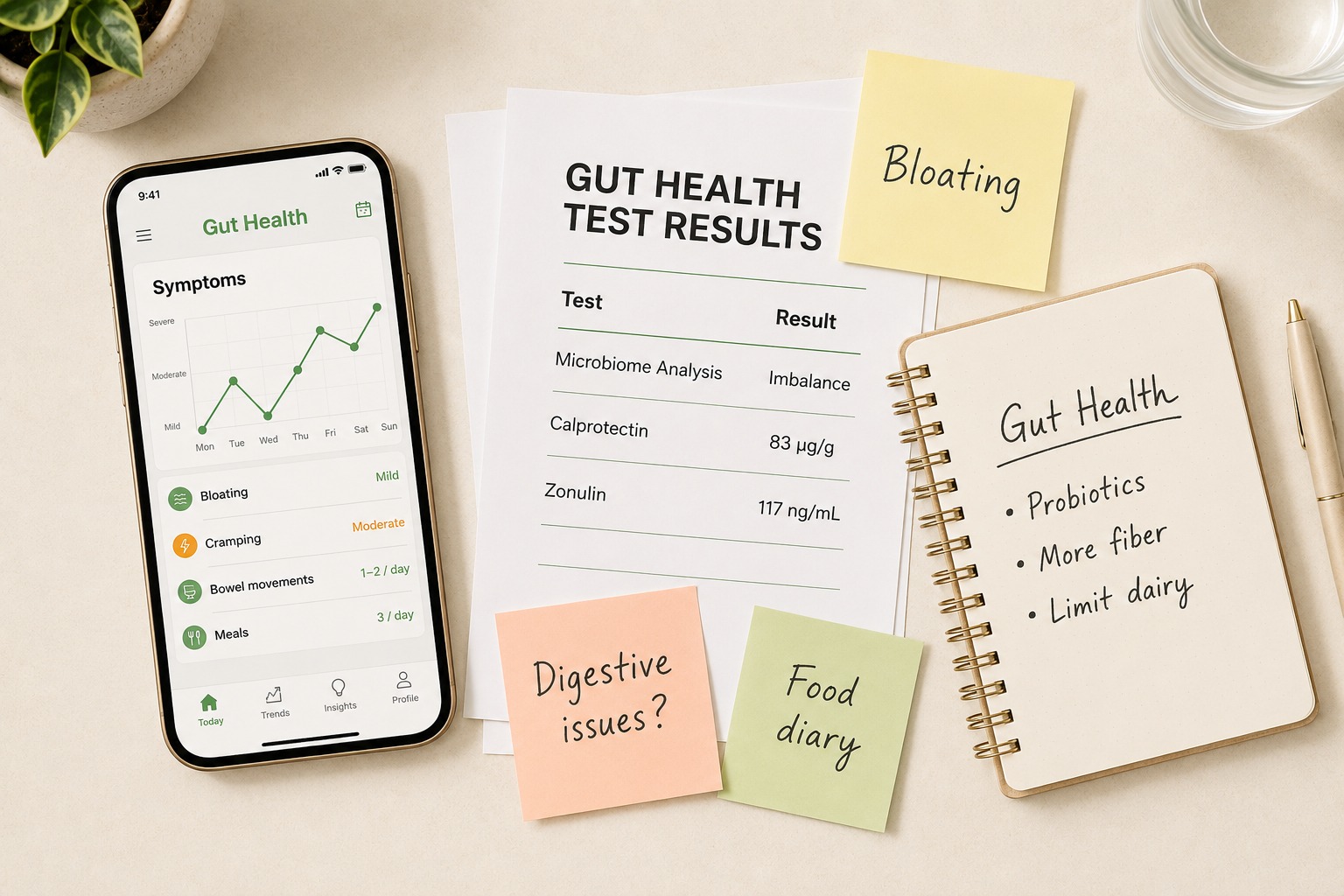
Why Scattered Notes Can't Show You Patterns
Patterns only show up when you can see more than one variable at the same time, in the same place. Did your symptoms get worse the same week you started magnesium, or the same week your stress went up, or both? You can't answer that by remembering. You have to be able to look at both timelines next to each other.
When your test results live in one app, your food notes live in another, and your practitioner's notes are from an appointment eight months ago, comparing any of it means digging through three or four places and lining up dates in your head. Most of the time, that comparison just doesn't happen. Not because you don't care. Because it's tedious, and tedious things get skipped.
I found this out at an appointment where a practitioner asked when my symptoms had gotten worse relative to a round of antibiotics I'd taken. I knew I'd taken them. I had no idea if it was before or after, because that lived in a pharmacy text from months earlier I'd never written down anywhere else. I guessed wrong, and we spent the appointment chasing the wrong timeline.
⚠️ Having a lot of notes can feel like being organized, even when it isn't. Eleven test results in a folder is not the same as eleven test results you can actually compare to each other.
There's also the part where you re-explain your whole history to every new practitioner, from memory, under time pressure, in a fifteen-minute appointment. Research on medical history recall backs this up: people are measurably inaccurate at recalling their own symptom timelines after the fact, even when they're genuinely trying. A study on episodic memory specifically in people with IBS found something similar: memories of flares are often incomplete or reconstructed rather than accurately recalled (source: Sayuk et al., Frontiers in Pain Research, 2022). It's not a personal failing. It's how memory works under those conditions.
People with hard-to-pin-down chronic conditions tend to live this more than once. One survey of people with fibromyalgia found it took an average of 2.3 years and 3.7 physicians to reach a diagnosis (source: Choy et al., BMC Health Services Research, 2010). Gut conditions usually follow a similar shape: years, several providers, and a stack of disconnected records nobody but you has the full picture of.
The Consolidation: What to Pull Together
A useful consolidated gut health history isn't a diary. It's a small number of dated categories you could hand to a new practitioner and have them understand your situation in five minutes instead of forty.
Test results. Every breath test, blood panel, stool test, and scan, with the date and reference range next to each number.
Protocols you've tried. Every supplement, antibiotic course, dietary change, or intervention, with rough dates and what you noticed. Timelines matter: Monash University's research on low FODMAP found roughly 3 in 4 people with IBS improve, usually within 2 to 6 weeks, so a protocol judged after one week isn't judged at all.
Your symptom timeline. A rough chronological account of when things started, what changed, and what got better or worse. It doesn't need to be exact, just in one place instead of scattered across every notes app you've used.
Practitioner notes and recommendations. What you were told, what got ruled out, what got suggested next. This is the easiest category to lose, since it usually only exists in your memory of a conversation from months ago.
Ongoing tracking data, if you have any. Export it from whatever app you used, even one you stopped using years ago. Old data is still data. (If you're starting tracking from scratch, here's what's actually worth logging beyond food.)
| Category | What to include | Why it matters |
|---|---|---|
| Test results | Breath tests, bloodwork, stool tests, imaging, with dates and reference ranges | Trends matter more than single results |
| Protocols tried | Supplements, antibiotics, diet changes, with dates and outcomes | Shows what's been ruled out |
| Symptom timeline | Rough chronological account | Shows what coincided with what |
| Practitioner notes | What you were told, ruled out, or recommended | Easiest to lose from memory |
| Tracking data | Exported logs, even old ones | Old data is still useful |
⚠️ Watch out: a test result without the reference range next to it is close to useless six months later. Normal ranges vary between labs, so "my number was 42" means nothing without knowing what 42 meant at the time.
🔎 If pulling all of this into one place sounds like a project you keep meaning to start: Noorish builds a structured gut health history from your symptoms, test results, and what you've tried, so it exists as one record instead of a pile of exports. Start here →
What the Consolidation Reveals
The first time I put everything in one place with actual dates next to it, the thing that jumped out wasn't a single supplement that worked. It was a six-week stretch the year before where my symptoms had quietly gotten worse, lining up almost exactly with the most stressful period I'd had at work. I'd lived through it without connecting the two. Laid out on one timeline, it was obvious within a minute.
That's the pattern with consolidation: nothing in any single record is new information. You already had the antibiotic course, the stress period, the flare, sitting somewhere. What's new is seeing all three on the same timeline, which is the only way the connection becomes visible. A pattern invisible across five separate sources can be obvious once you can see all five at once, even without anything close to a formal experiment.
This also changes what an appointment looks like. Instead of reconstructing your history out loud under time pressure, you're handing someone a record. Instead of "I think I tried something for SIBO, maybe over the summer," you have a dated entry. Suma Magge, MD, a gastroenterologist at Norwalk Hospital in Connecticut, has described trying to get a real sense of someone's specific symptoms so she can target her approach to that pattern, not to IBS in general (source: American Medical Association, "What Doctors Want Patients to Know," 2023). That's easier on both sides when the pattern is already written down instead of reconstructed from memory. (More on what's actually worth bringing into that appointment →)
💡 Worth knowing: you don't need to interpret the pattern correctly yourself. You just need it to be visible. Working out what a pattern actually means is a separate step, and it's a lot easier with a practitioner once there's something concrete to look at together.
This is the part Noorish is built around: turning your test results, protocols, and symptom history into one structured record instead of a pile of exports and screenshots, so the pattern is visible without reconstructing it every time. If you've already lived the scattered-notes phase, consolidation is what changes what you can see.
Conclusion
None of this is the actual fix for whatever's going on with your gut. Consolidating your history doesn't resolve a SIBO overgrowth or settle a flare on its own. What it does is make the rest of the work possible. You can't spot a pattern in information you can't see laid out in front of you, and you can't test a theory about what's driving your symptoms if you don't actually know what you've already tried and when.
Pulling everything into one place is the unglamorous part, closer to admin than to a breakthrough. But it's the admin everything else depends on. Skip it, and you're stuck re-explaining your situation from memory at every appointment, guessing at timelines, and re-trying things you may have already ruled out two years ago without realizing it.
🔎 Noorish: Gut Health Action Plan
Stop carrying your gut health history in your head, build one structured record you can actually see and use.
- ✅ Build a structured gut symptom history to share with your doctor
- ✅ Understand what's actually driving your symptoms
- ✅ Get a science-based action plan for what to try next
- ✅ Optional: validation from a real nutritionist
If you're in the middle of your own scattered-notes phase, I post about this kind of thing on Instagram as I go.
FAQ
How do I keep track of my gut symptoms over time?
Pick a small number of things to log consistently (symptom type, severity, timing, and what you ate or did beforehand) and stick with the same format every time. Consistency matters more than detail. A simple log you actually keep up for three months beats a detailed one you abandon after a week.
What should I include in a gut health journal?
At minimum: symptoms with dates, what you ate, sleep and stress notes, and anything you tried (supplements, medications, dietary changes) with rough start and stop dates. The goal is being able to compare any two points in time later, so dates matter more than most people think.
How do I organize my medical history before a doctor's appointment?
Pull together your test results with dates, a short timeline of when symptoms started and changed, and a list of what you've already tried with outcomes. Bring it as one document, not as a verbal summary you're reconstructing in the waiting room.
What is the best app for tracking IBS symptoms?
There isn't one single answer. What matters more than the specific app is whether it lets you export your data and actually shows you patterns over time, instead of just collecting entries. Noorish is built specifically around turning that tracking into a structured history and action plan, rather than a list of logged days.
How do I keep track of what supplements I've tried?
Write each one down with the date you started, the date you stopped (or "still taking"), and what you actually noticed, even if the answer is "nothing." That last part matters: knowing what didn't do anything is just as useful as knowing what did, and it's the first thing people forget once enough time passes.
Why is having a health history important for gut conditions?
Because gut conditions tend to be chronic and multi-factor, which means the answer is rarely obvious from a single test or appointment. A history is what lets you, or a practitioner, see the pattern across tests, protocols, and time instead of looking at each piece in isolation.